
My Interests
PAST ELECTRONIC INTERESTS:
I have always, even as a child, been interested
in how things worked and how
they were put together. When I was three
years old someone brought me a big
red plastic fire truck which actually squirted
water through the fire hose.
Before the person who had brought the present
left, I had the fire truck all
taken apart. My dad could not figure out
how to get all the pieces back
together, and my parents were really angry!
I know that as a kid, the site of a soda machine
taken apart intrigued me.
What was inside there? What made it work?
I used to find old radios lying
in prairies and would examine their insides.
I would open up the capacitors
and find nothing inside other than something
like tin foil. Where was the
magic? I would take apart alarm clocks
and examine the gears. Whenever I
would get something new, I would look forward
to the day when I could take
it all apart - this drove my parents crazy!
When I grew to be a teenager, my interests became
more directed towards
electronics. Absorbed in science fiction
programs on TV, I attempted to
construct a control system which consisted of
a master control and auxiliary
control. Master control could override
auxiliary control, and there was a
way for auxiliary control to override master
control if you knew how to do
it. This all revolved around a canister-type
vacuum cleaner on wheels which
would roll across our basement floor. My dad
thought it sounded like a jet
airplane, especially with the system I had invented
for gradually increasing
the speed of the 660-watt motor. This was great
fun when friends came to
visit, and I constantly found ways to re-wire
and revise the system. At the
time I was around 15 years old and did not have
access to a camera or
computer to document this. I did, however,
have access to a typewriter and
hope to update these documents to computer format.
When I have this
available online, you can click here to see it.
During my later high-school years I began to collect
and disassemble broken
televisions and radios. I also collected
old training manuals concerning
TV/radio repair and broadcast signal standards.
In my junior year of high
school, I built a 5-tube AM radio receiver.
By the time I graduated from
high school, I was repairing radios and TVs in
my basement workshop.
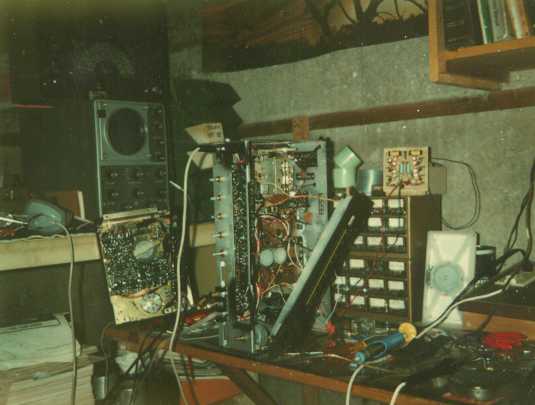
Click on these pictures to see a larger version:
 _
_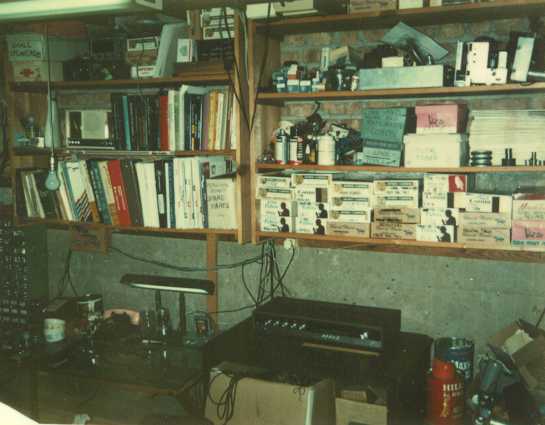 _
_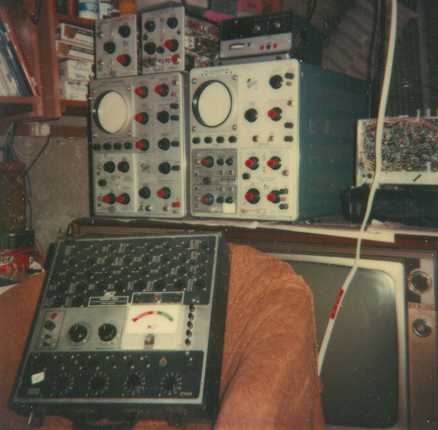
This basement workshop and the test equipment
are now just fond memories of
an obsolete era of my life. I thought that
I could build a better mousetrap
and make my fortune as an inventor. Most
of my time was spent repairing
radios, TVs, and stereos for relatives, coworkers,
etc.
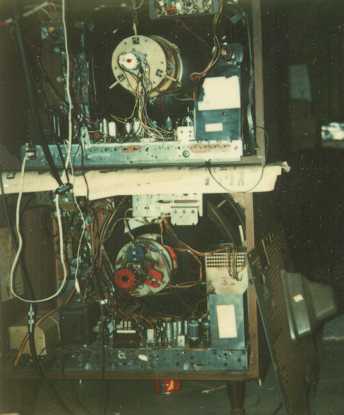 _
_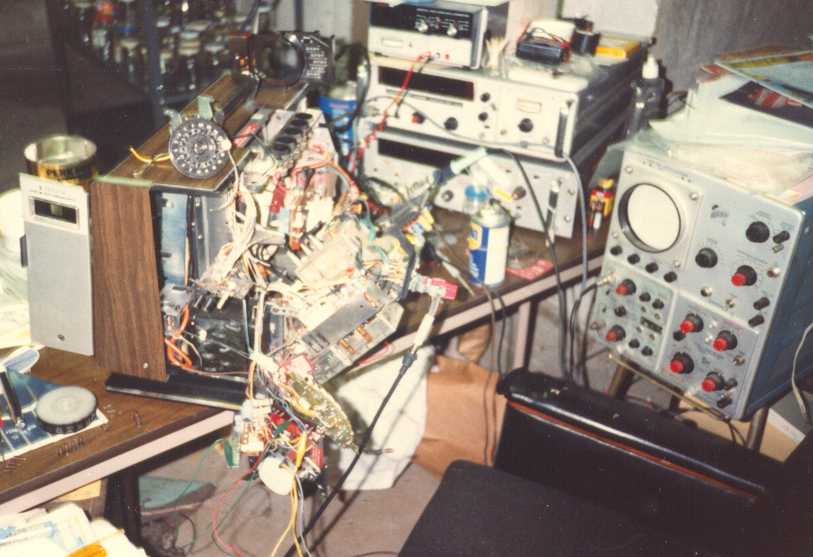 _
_
There was one little project which I built during
this time which was
somewhat revolutionary, and represented the height
of my achievements in
this area. I designed a multi-purpose box
which controlled my basement
workshop. These are the functions which
it performed:
** It monitored the phone line and if it
detected an incoming call would
use a ringing generator to ring "illegal" extension
phones. This was back
in the 1970's and I was told that Illinois Bell
would measure the ringing
current to detect if there were any unauthorized
extension phones on the
line. My box would monitor the phone line
through a 1,000,000 ohm resistor
so the current drain was minimal.
** It monitored the lighting in the area
using a photocell to determine if
someone was there. If the fluorescent lights
were on in my workshop and
there was a power failure, it would use a battery
backup to start an
overhead 12-volt fluorescent light so I would
not be left in the dark.
** Using another photocell it also monitored
the light by the stairway
leading down into the basement. If someone
stood at the top of the stairs
and turned the south basement light on, off,
on, and off again it would
light the stairs for a predetermined number of
seconds to give the person
time to get down to the workshop. This
was useful because my mother and I
would "live" in the workshop area and once you
got downstairs there was no
way to turn the basement light off since the
switch was at the top of the
stairs. My mother requested this feature
so we could save money on our
electric bill.
** If a special button was pushed on the
control panel it would light the
stairs so someone could go back upstairs.
** There was a hold circuit such that someone
could be put on hold in my
bedroom or in the basement workshop and taken
off hold in the destination
location. There was a hold switch and indicator
on the main control panel,
and a switch and indicator on a smaller control
panel in my bedroom.
This little box also had some special design features:
** All main circuitry was implemented on
plug-in circuit cards. These
cards could be removed for easy troubleshoot
and repair. The most critical
circuit board had a spare copy made to act as
a backup.
** When the case was closed, all adjustment
circuitry was still accessible
from the outside of the case through the ventilation
holes.
** All interconnections were through double
banana plugs on the back of the
unit.
There was also an eight-ampere power supply with
battery backup which was
used to power this and the stereo system in my
basement workshop. It was
constant and variable-voltage outputs.
UNFORTUNATELY, so much of me went into this project
that I could not throw
it away when it was no longer being used.
Since I still have the pieces of
the project and the plans which I used when I
created it, I should be able
to digitize all this. Maybe then I will
be able to destroy these memories
of the past and finally let go of that which
I can't admit I have lost.
Here are the plans.
Here is the control
panel.
Here is the power supply.
PAST COMPUTER INTERESTS:
When I was in high school and people saw what
I was interested in and how my
mind worked, they said I should be a computer
programmer. I did not see
that as the real challenge. I thought that
I would design and build
computers, and instead pursued a career in electronics.
Besides, computers
in the 1970's were programmed through key punch
machines and Hollerith cards
- hardly fun!
My first memory of being really interested in
having my own computer was in
the late 1970's. People were starting to
build home computers, and I
remember playing with a Teletype machine at work
and storing messages on
paper tape. Click here
to see an example of a Teletype paper tape message from that
period.

As my career in electronics progressed, I realized
that although I could
build things using my skills, the real magic
was in the programming which
made it work. I always thought that I would
build my first computer, and
spent countless hours studying microprocessor
data sheets, memory chip
timing diagrams, and looking briefly at Assembler
language and compilers.
Eventually, I decided that it would be better
to buy a computer and see if I
enjoyed working with it before committing to
a huge project.
My first computer was a Commodore VIC-20 which
I bought for $80 at K-mart in
the early 1980's. At first, I didn't have
the cassette backup unit, and had
to manually type BASIC programs into the machine
every time I wanted to run
them. My parents bought me the cassette
unit for my birthday. The machine
came with 4KB of memory built-in. At a
later date I bought the 16KB memory
add-on for $100. With 20K of RAM, I thought
I was set! When I bought the
VIC-20 I already owned a Teletype machine.
I constructed an RS-232 to 20ma
current loop interface using opto-isolators so
I could use the Teletype as a
printer. Eventually, I purchased a used
Heathkit dot matrix printer to use
with the VIC-20.

My next computer - and my first "real" computer
- was a Kaypro II. It ran
the CPM operating system which was a standard
at the time. It had 64K of
RAM (how could I ever need more?), two 200K floppy
drives, a built-in
monitor and keyboard, a printer port and a serial
port. I remember being at
the computer store where I had bought it - the
salesman thought it was so
complicated, and wanted to tell me how to use
it. I had already looked at
the manuals, and thought it was a cinch.
I interrupted his talk about how
to use the machine and said "What I need to know
is how to input saved
programs on paper tape from a Teletype machine
into the Kaypro." He
stopped, gave me a totally blank look, and told
me he had no idea what I was
talking about. He realized that I was way
ahead of his little tutorial. I
later discovered that I could give the Kaypro
a command to switch the system
console out to the Teletype which allowed me
to feed the paper tape into the
Teletype after using the keyboard to enter the
BASIC program - the Kaypro
just thought it was the world's fastest BASIC
programmer.

I used the Kaypro for quite a number of years,
and I have fond memories of
all that it taught me concerning telecommunications,
programming, word
processing, spreadsheets, etc. Eventually,
as I neared the end of the
1980's, I realized that the world was being taken
over by the IBM PC. For
years I admired them from afar, but they were
way out of my reach
financially. When I bought the Kaypro,
all the hardware and all the
software was $1500. Buying the IBM with
the hardware only was $3500!!
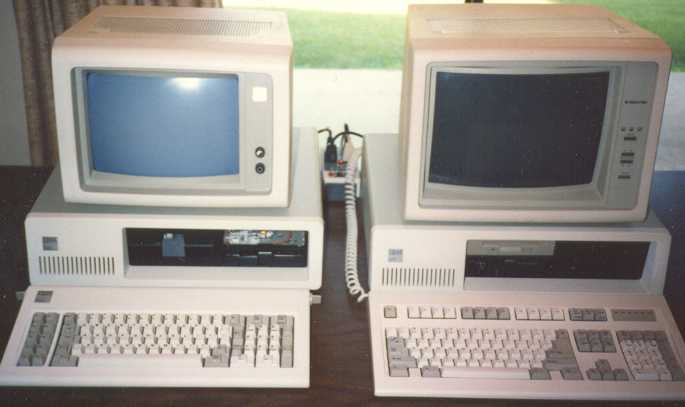
Around 1988 I managed to buy a used IBM PC (not
an XT).
One of my first challenges was to get my programs
working on this new
operating system. After all, this was not
CPM, it was PC-DOS. For
instance, I had a program which I had written
in COBOL. When I converted to
the IBM PC, I wanted to make it work in some
language which was easy to use
on that machine. As I recall, I re-wrote
the program in BASIC and when I
could not get it to work, re-wrote it yet again
in Pascal. The Pascal
version worked fine. Another example of
a program which I used extensively
was one which I created to allow me to change,
test, and reset printing
parameters on my Epson RX-100. I never
really finished the program as I
originally designed it, but the functionality
it provided was very useful.
I immediately sunk hundreds of dollars into the
IBM PC to buy extra memory
and interface cards. By constantly updating
this machine I learned a great deal
about computer hardware, although it was a very
expensive lesson.
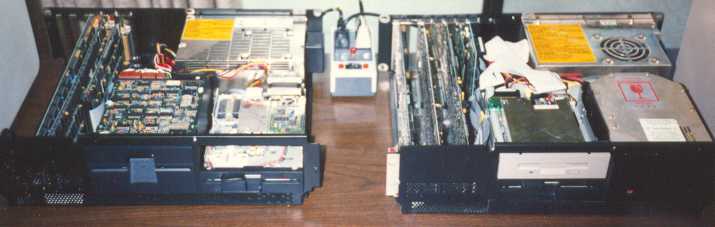
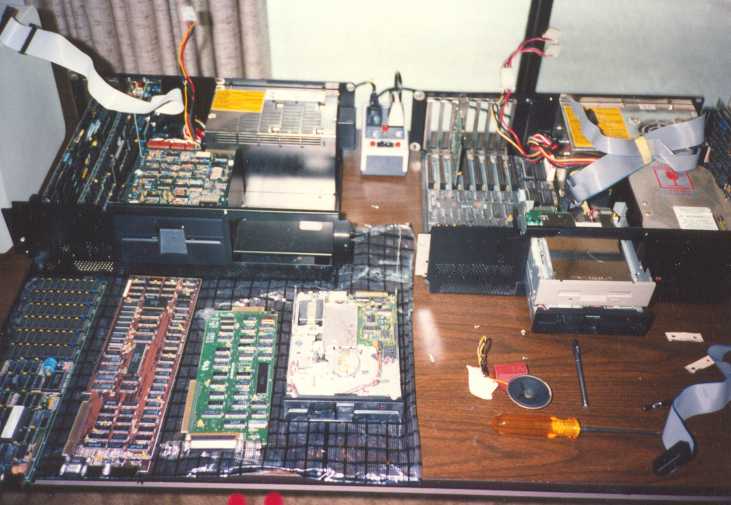
Eventually I had replaced everything in the machine
except for the
motherboard. I could not afford a new computer,
so someone convinced me
that replacing the motherboard was not a big
deal. In 1990 I bought a book
to guide me through the intricacies of the process
and bought an 80386SX
20MHz motherboard for $300. At that point,
I had replaced everything in the
case and was able to build a computer from scratch.
Over the next few years
I continued learning more and building computers,
eventually becoming a
network administrator.
 _
_ _
_
Return to Phil home page.